

To become a certified welding inspector in the US, you usually earn the AWS Certified Welding Inspector (CWI) credential. You need a set number of years of welding-related work (five years with a high school diploma), a passing vision test, and at least 72% on each of three exams: Part A (fundamentals), Part B (practical) and Part C (code book) (AWS).
If you don't have enough experience yet, AWS's entry-level CAWI credential has lower experience minimums. This page goes through each step.
Step 1: Check the experience requirement
AWS combines education and welding-based work experience. More education means fewer years of work, but there is always a minimum.
| Your education | Minimum welding work experience |
|---|---|
| Bachelor's or higher in welding engineering or welding technology | 1 year |
| Associate's or higher in welding, engineering technology, engineering or a physical science | 2 years |
| Engineering or technical courses that count toward a welding bachelor's degree | 3 years |
| Trade or vocational courses | 4 years |
| High school diploma or equivalent | 5 years |
| 8th-grade schooling | 9 years |
| Less than 8th grade | 12 years |
Source: AWS's CWI page. AWS asks for welding-based work experience and documented proof of both education and experience. Check the current application for what work counts.
You also need to pass a vision test. AWS's CWI program follows AWS QC1, which sets the vision standard. Check AWS's current application for the exact test and form.
Not enough years yet? The CAWI
The Certified Associate Welding Inspector (CAWI) uses the same three exams with lower experience minimums: two years with a high school diploma, for example, or six months with two years of post-high school education in welding, engineering technology or physical sciences (AWS CAWI page). A CAWI works under the supervision of a CWI. It lasts three years and cannot be renewed, so it is a stepping stone. Our CWI vs CAWI page compares the levels, and entry-level welding inspector jobs covers getting a first job as a CAWI.
Step 2: Apply and choose a code
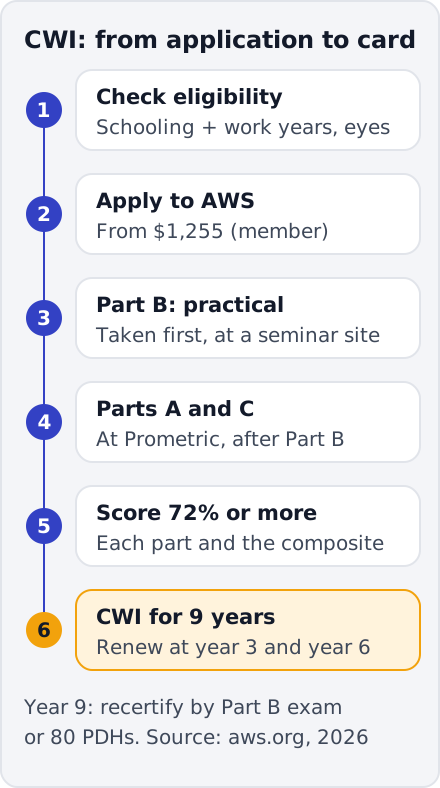
You apply to AWS for the exams. In 2026 the initial exams cost $1,255 for members and $1,520 for non-members (AWS price list). See CWI exam cost for seminars and retests.
You also choose the code for Part C. For structural steel, that is AWS D1.1 (the 2020 edition in AWS's current Part C guide). Other choices include API 1104 for pipelines, D1.5 for bridges and ASME Section IX with B31.1 and B31.3 for pressure piping. Pick the code used in the work you want to inspect.
AWS asks for applications about six weeks before the Part B date in the US.
Step 3: Take the three exams
| Part | What it is | Format |
|---|---|---|
| Part B: Practical | Inspection tasks with AWS-supplied tools and replicas, plus 46 questions | At an AWS seminar location, taken first |
| Part A: Fundamentals | 165 questions (150 scored) across 11 topics, 135 minutes | Closed book, at Prometric |
| Part C: Code Application | 50 to 60 scored questions on your chosen code, 120 to 135 minutes | Open book, at Prometric |
You need 72% on each part and a 72% composite across all three. Scores are emailed about two weeks after you finish Parts A and C. If you fail a part, AWS's CWI page says you complete all three parts before retaking any of them.
Many candidates take an AWS seminar before the exams, in person or online, though it is not required. For study, start with the free Part A diagnostic, then work through the study guides for your weakest topics. The CWI practice test page explains how to use practice questions, and the Part C guide covers tabbing your code.
Step 4: Keep your CWI current
AWS says a CWI is valid for nine years:
- Years 3 and 6: renewal, usually by showing continued work experience. You can apply up to 11 months early. AWS recommends applying at least 60 days before the due date, and there is a 60-day grace period with late fees after it.
- Year 9: recertification, by passing Part B again, earning 80 professional development hours (PDHs), earning the CRI certification, or taking an endorsement exam before the ninth year.
What a welding inspector does
A CWI checks that welding work meets the code or specification the job is built to. That includes work before welding (reviewing procedures, welder qualifications, materials and fit-up), during welding (preheat, technique, consumables) and after welding (visual inspection, dimensions, and reviewing NDT results). Inspectors work in structural steel, pipelines, pressure vessels, shipbuilding, manufacturing and other industries.
AWS does not publish salary data for CWIs, and BLS does not have a separate category for welding inspectors, so we don't quote a salary figure here.
Frequently asked questions
How many years of experience do you need to be a CWI?
It depends on your education. With a high school diploma, AWS requires at least five years of welding-based work experience. With a bachelor's degree in welding engineering or welding technology, it is one year. With less than an 8th-grade education, it is twelve years.
Can I become a welding inspector without being a welder?
AWS asks for welding-based work experience, which is not limited to working as a welder. Check AWS's current application for which roles count and how they are documented.
How long does it take to become a CWI?
The experience requirement is the long part: one to twelve years depending on education. Once you meet it, you take Part B first and then Parts A and C. AWS says scores arrive about two weeks after you finish Parts A and C.
What is the difference between a CWI and a CAWI?
A CWI can inspect on their own. A CAWI works under the supervision of a CWI. The CAWI has lower experience minimums, lasts three years and cannot be renewed. Both use the same three exam parts. See the CWI vs CAWI comparison.
Do I need to take a seminar to become a CWI?
No. AWS offers seminars as a review, but you can take the exams without one. The seminar and exam package costs $3,070 for members in 2026, compared with $1,255 for the exams alone.
How long is a CWI certification good for?
Nine years, with renewals at years three and six. At year nine you recertify, for example by passing Part B again or earning 80 professional development hours.
We are not affiliated with AWS and never see real exam questions. Every question is written from AWS's public content outline and the standards it names, so nothing here is a leaked or recalled item. How we write questions
Questions? support@cwiready.com