


A welding symbol is built on a horizontal reference line with an arrow that points to the joint. A weld symbol drawn below the line means the weld goes on the arrow side of the joint, and one drawn above the line means the other side. Sizes go to the left of the weld symbol and lengths to the right. These rules come from AWS A2.4, Standard Symbols for Welding, Brazing, and Nondestructive Examination.
The diagrams on this page are our own drawings of those conventions, made to help you read symbols on drawings and on the CWI Part A exam.
The parts of a welding symbol
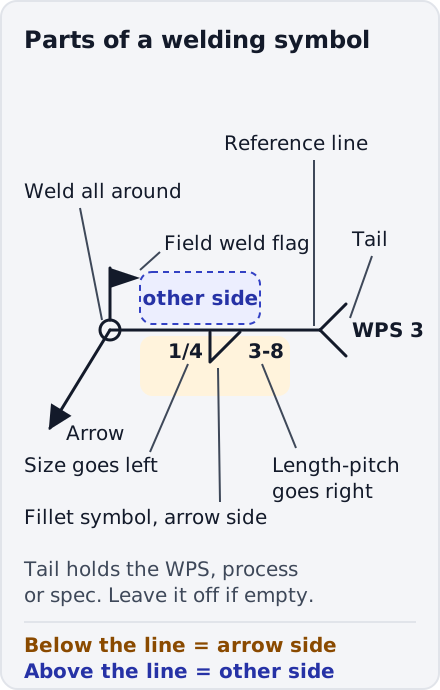
| Part | What it tells you |
|---|---|
| Reference line | The base of the symbol. Always drawn horizontal. Everything else is placed relative to it. |
| Arrow | Points to the joint. The side it touches is the arrow side. |
| Weld symbol | The type of weld, such as fillet, V-groove or plug. |
| Dimensions | Size or depth to the left of the weld symbol, length and pitch to the right. |
| Supplementary symbols | Extra instructions, such as field weld, weld all around or contour. |
| Tail | Optional. Holds a specification, process or WPS reference. Left off when nothing is needed. |
One term that trips people up: the weld symbol is the small shape for one weld type. The welding symbol is the whole assembly. CWI questions use both words, and they mean different things.
Arrow side and other side
This is the first rule to learn, and the one most often tested.
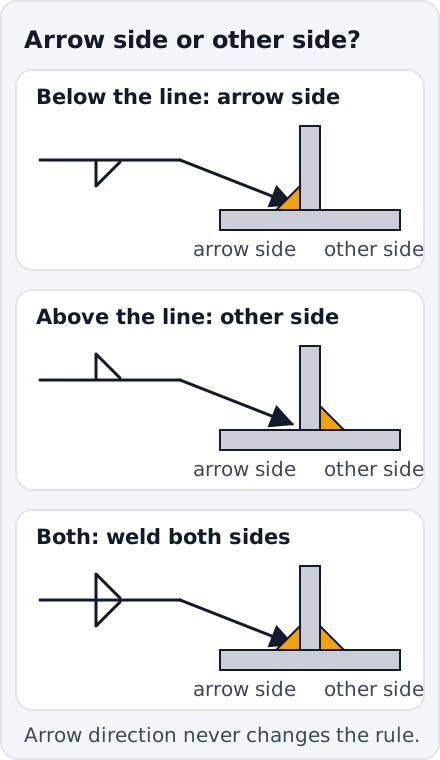
- Below the line: weld on the arrow side.
- Above the line: weld on the other side.
- Both sides: weld both sides of the joint.
The rule does not change when the arrow points left instead of right, or when the drawing is flipped. The tail never tells you a side. The arrow side is simply the side of the joint the arrow touches.
Basic weld symbols
These are the weld symbols you will see most often. Each one below is drawn on the arrow side (below the line).
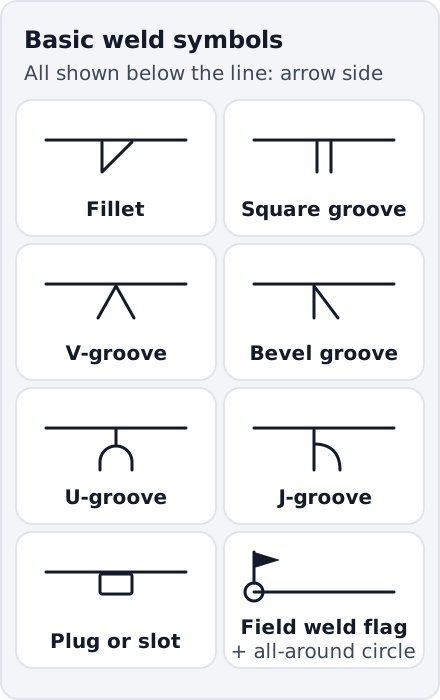
| Symbol | Shape | Notes |
|---|---|---|
| Fillet | Right triangle | The vertical leg is always drawn on the left. |
| Square groove | Two parallel lines | No edge preparation. A root opening may be shown between the lines. |
| V-groove | Two lines meeting at the reference line | Both members are prepared. |
| Bevel groove | One vertical line and one slanted line | Only one member is prepared. The vertical leg is on the left. |
| U-groove | Stem and curved cup | Both members are prepared with a curved groove. |
| J-groove | Vertical line and curved line | One member is prepared with a curve. The vertical leg is on the left. |
| Plug or slot | Rectangle | Hole size to the left, pitch to the right. |
| Field weld | Flag at the arrow end | Weld made at the site, not in the shop. |
| Weld all around | Circle at the arrow end | Weld continues around the whole joint. |
For bevel and J-groove welds, an arrow with a break points to the member that gets the preparation. The break can be left out when it is obvious which member is prepared.
Dimensions: where the numbers go
Fillet welds
- Size to the left, such as 1/4 for a 1/4 in. fillet.
- Length to the right. No length means the weld runs the full length of the joint.
- Pitch after the length, joined by a hyphen. In 3-8, the welds are 3 in. long and spaced 8 in. center to center. Pitch is measured center to center, not the gap between welds.
Groove welds
- Depth of preparation to the left with no parentheses.
- Groove weld size to the left in parentheses, so 3/8 (1/2) is a 3/8 in. preparation depth with a 1/2 in. weld size.
- Root opening inside the symbol.
- Groove angle outside the symbol, away from the reference line.
For a single groove with no depth or size given, the symbol calls for complete joint penetration. Our how to read welding symbols page works through full examples, and the symbols study guide covers more cases, including staggered and chain intermittent welds, contour and finish letters, backing and melt-through, and NDE symbols.
A 5-step way to read any welding symbol
- Find the arrow and the joint. Which side of the joint does the arrow touch?
- Check above and below the line. Below is the arrow side, above is the other side, both means both.
- Name the weld symbol. Fillet, groove type, plug or other.
- Read the numbers. Left is size or depth. Right is length and pitch. Inside a groove is root opening. Outside is groove angle.
- Look at the arrow end and the tail. Field weld flag, weld-all-around circle, then any process, specification or WPS in the tail.
Try it on the anatomy diagram above: a 1/4 in. fillet on the arrow side, 3 in. long welds at 8 in. pitch, all the way around the joint, welded in the field, to WPS 3.
Welding symbols on the CWI exam
Symbols are one of the larger Part A topics. AWS's Part A exam information lists a minimum of about 10% of the exam for welding and NDE symbols, and Part A is closed book, so you need the rules memorized. Questions often show a symbol and ask what it requires, or describe a weld and ask which symbol is correct.
Test yourself with the free symbols practice questions, or take the free CWI Part A diagnostic to see how symbols compare with your other topics. The CWI exam overview has the full format.
Frequently asked questions
What does a weld symbol below the line mean?
A weld symbol below the reference line means the weld goes on the arrow side of the joint, the side the arrow touches. A symbol above the line means the other side. Symbols on both sides mean weld both sides.
What is the difference between a weld symbol and a welding symbol?
A weld symbol is the small shape for one type of weld, such as the triangle for a fillet. A welding symbol is the whole thing: reference line, arrow, weld symbols, dimensions, supplementary symbols and an optional tail.
What does the flag on a welding symbol mean?
The flag means field weld. The weld is made at the job site, not in the shop. It sits at the junction of the arrow and the reference line.
What does the circle on a welding symbol mean?
A circle at the junction of the arrow and reference line means weld all around. The weld continues around the whole joint, including corners.
Where does the fillet weld size go?
To the left of the fillet weld symbol. The length goes to the right, and the pitch follows the length after a hyphen, measured center to center.
Which standard covers welding symbols?
In the US, AWS A2.4, Standard Symbols for Welding, Brazing, and Nondestructive Examination. Other countries may use ISO 2553, which draws the other side differently with a dashed line, so check which standard a drawing uses.
Sources
Our Symbols: Welding and NDE questions cite these documents, by document and, where we can confirm it, chapter or section.
- AWS A2.4 (28 questions)
We are not affiliated with AWS and never see real exam questions. Every question is written from AWS's public content outline and the standards it names, so nothing here is a leaked or recalled item. How we write questions
Questions? support@cwiready.com